English| EUR
Suggested for you
More currencies
Choose a language
Cruise ships dock at Kochi's Ernakulam Wharf or the Samudrika cruise terminal, placing passengers 8-12 kilometers from Fort Kochi's colonial quarter and the city's most photographed landmarks. Shore excursions promise curated logistics and guaranteed return times, but Fort Kochi's compact layout and free-entry public areas make independent exploration viable for first-time visitors. The question hinges on how much control, time, and interaction with local guides matters during your six to eight hours in port.
Quick answer
Shore excursions in Kochi are worth it for first-time cruise visitors who want guaranteed logistics and expert commentary on the city's Dutch, Portuguese, and British colonial layers without navigating ferry schedules or negotiating auto-rickshaw fares. Fort Kochi itself charges no general admission fee, and its central landmarks sit within a two-kilometer walking radius, making independent exploration cost-effective for confident travelers. The organized tour advantage centers on time efficiency and access to guides who explain the architectural palimpsest that casual walking misses.
Fort Kochi holds the highest density of standing colonial architecture on India's western seaboard, with Dutch gables, Portuguese verandas, and British administrative blocks occupying the same narrow lanes. The district operates as open public space rather than a ticketed heritage zone, which fundamentally alters the value equation for cruise passengers evaluating whether shore excursions worth it in a city where the primary attraction charges nothing to enter. Organized port tours in Kochi cluster around three itineraries: half-day Fort Kochi walks that cover the Chinese fishing nets, St. Francis Church, and the Dutch Cemetery; full-day circuits adding Mattancherry Palace and the Jewish Quarter's spice markets; and cultural immersion packages incorporating Kathakali dance demonstrations or backwater canoe tours in Kumbalangi. The logistical envelope matters more than the sights themselves, because independent travelers face the same 8-12 kilometer gap between cruise terminals and Fort Kochi that organized coaches bridge automatically. Public ferries from Ernakulam Boat Jetty to Fort Kochi Jetty run every 25 minutes and cost under 10 rupees, but the schedule demands attention and the return window tightens if your ship departs before 17:00. The interpretive advantage tilts toward guided excursions when the subject is architectural history rather than visual spectacle. Fort Kochi's building facades layer Dutch step gables atop Portuguese foundations, with British-era weather boarding and Indo-Saracenic detailing added during successive occupations. Independent walking captures the streetscape but misses the construction chronology, the trade-route economics that funded each phase, and the specific governors and trading companies whose names attach to warehouses now converted into cafes. Licensed guides who lead shore excursions carry the archival detail that converts a pleasant harbor walk into a three-century mercantile narrative. Kochi cruise excursions include return transport and pre-negotiated entry to sites that require tickets, which matters most for Mattancherry Palace and the Paradesi Synagogue in the Jewish Quarter. Auto-rickshaw drivers at the port offer day rates between 800-1,200 rupees, and English-speaking private guides list on municipal tourism registers at fixed hourly fees, creating a middle path between full independence and packaged tours. The Fort Kochi waterfront maintains its attraction through daylight hours, with the best arrival window from early morning through late afternoon when the Chinese fishing nets operate and the colonial streetscape photographs clearly under natural light.
“Fort Kochi's building facades layer Dutch step gables atop Portuguese foundations, with British-era weather boarding added during successive occupations.”
This framework suits cruise passengers with four to six hours in port who want to explore Fort Kochi independently. The route covers the core colonial quarter and waterfront on foot, with flexibility to linger or skip stops based on your interests.
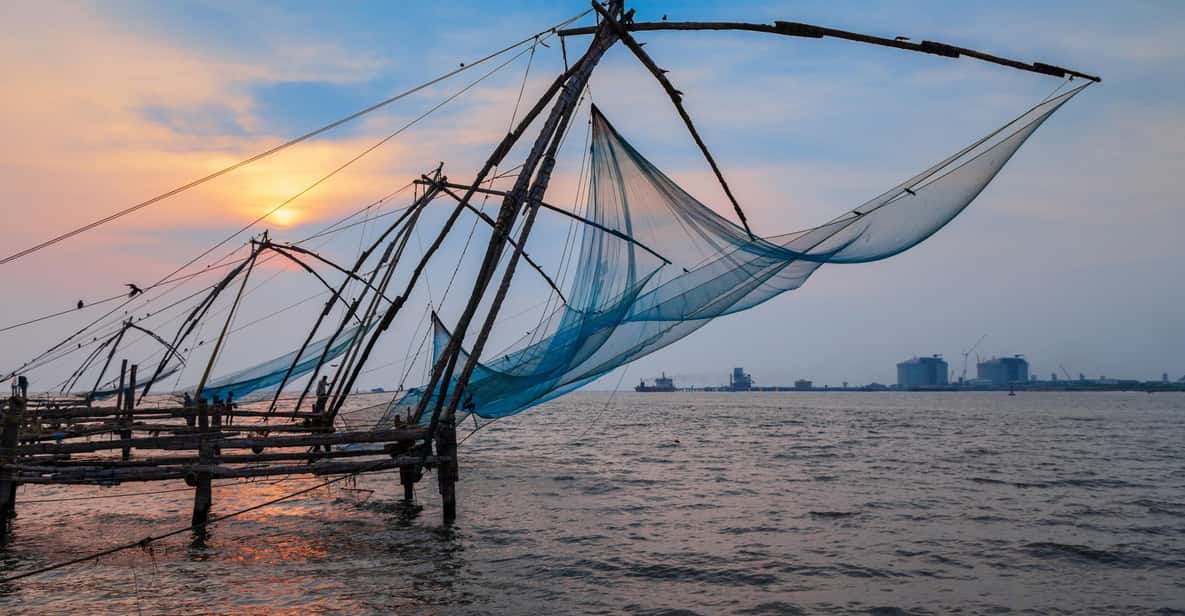
Begin at the northern tip of Fort Kochi where the iconic cantilever nets line the shore. Operators demonstrate the system and offer photo opportunities; allow 30–40 minutes including the walk along the promenade.
Head south through Calvathy Road and Princess Street to see the Dutch, Portuguese, and British-era buildings, including the Dutch Cemetery and old trading houses. The compact quarter takes 60–90 minutes at a relaxed pace with stops for photos.
Visit India's oldest European church, where Vasco da Gama was originally buried, then cross to the adjacent parade ground for views of the bay. Budget 30 minutes for both.
A 15-minute walk or short rickshaw ride brings you to the Dutch Palace's murals and the synagogue district; combined visit takes 60–75 minutes. Spice markets and antique lanes fill the surrounding streets.
If time allows, browse the open spice warehouses near the synagogue or head back toward the port via the waterfront. A guided excursion adds context to the murals and trading history, but the route itself is straightforward and well-signposted.
Fort Kochi is located approximately 10 to 12 kilometers from the main cruise terminal at Willingdon Island. The most direct approach for visitors is via taxi or pre-arranged transport to navigate the local road network effectively.
Direct route via NH966B to Fort Kochi
Private transfer via NH966B
Ferry from Willingdon Island Jetty to Fort Kochi
Plan your arrival between 06:00 and 18:00 to ensure sufficient daylight for viewing the colonial architecture and the Chinese fishing nets. Securing a reliable taxi or excursion transport from the terminal exit is the most efficient way to reach the historic district.
Admission costs for sightseeing in Kochi depend primarily on whether you visit public areas independently or select guided tours that include private entry to specific heritage sites. Most colonial areas and public attractions in Fort Kochi do not require an entrance fee.
Verdict: A typical adult pays 0 INR to explore the general public area, though costs will increase if you choose to enter specific privately managed heritage sites or museums.
Shore excursions in Kochi often fail because visitors underestimate distances or misread the port's layout. Most mistakes stem from poor time allocation rather than the destination itself.
Assuming all Fort Kochi landmarks are walking distance from the cruise terminal
The terminal at Ernakulam is across the harbor from Fort Kochi's main sites. Budget 30–45 minutes for the ferry crossing or taxi route, plus waiting time during peak arrivals.
Booking a full-day tour when your ship docks for six hours
Calculate backward from all-aboard time, subtract embarkation buffer (60 minutes minimum), travel to and from port, and meal stops. A realistic excursion window is often three hours or less.
Expecting Chinese fishing nets to operate during your midday arrival
The nets are most active at dawn and dusk when tidal conditions favor fishing. Midday visits offer photo opportunities but rarely working demonstrations.
Ignoring that Fort Kochi's appeal is architectural, not a single ticketed attraction
The neighborhood rewards slow exploration of Dutch and Portuguese buildings, synagogues, and spice warehouses. Visitors expecting a single headline site often leave disappointed.
Planning heritage walks without checking the heat index during port calls
Kochi's humidity peaks between April and September. Walking tours scheduled during 11:00–15:00 arrivals require covered routes, hydration stops, and realistic distance expectations.
Everything you need to know about are shore excursions worth it
Deciding if are shore excursions worth it depends on your comfort with local navigation and your desire for guided context. Many travelers find that guided logistics simplify the experience of managing time in a busy port city.
A Kochi guided shore tour offers curated insight into the history of colonial architecture and the local spice trade. These structured visits often include transport, which helps maximize your limited time ashore.
If you prefer independent travel, you may find that managing your own transit to attractions like the Chinese fishing nets is feasible given the general public access. Ultimately, whether are shore excursions worth it for you depends on how much you value convenience over self-directed exploration.
The best arrival window for viewing colonial architecture and the Chinese fishing nets is 06:00–18:00. Daylight is essential for capturing the character of these historic sites.
For families, are shore excursions worth it often comes down to the convenience of pre-arranged logistics and safety. Having a dedicated vehicle can significantly reduce the stress of navigating public transport with children.
General public areas of Fort Kochi have an entry fee of 0 INR. Since entry is free, the cost you pay for a tour goes toward professional guidance and transport rather than admission tickets.